Showing posts with label Review Games. Show all posts

Monday, March 9, 2026

Math Games for St. Patrick's Day


Do you add centers to your math rotations with holiday spins? I love to do that whenever I can. Here's a look at a few math games for St. Patrick's Day. Adding centers with a holiday spin can sure spice up my math rotations. 


This game helps students practice equivalent fractions with 2-4 players.


Need more practice with rounding decimals to the tenths place? This is just the game to get in some extra practice. This is for 2-4 players.


This resource comes with three different games for multiplication fact fluency and offers room for differentiation too! 


Click on the titles to be taken to the resources. 

Monday, February 16, 2026

Test Prep Without Stress: Fun Test Prep Review Games for Grades 3-5 That Students Actually Love

By February, test prep season starts creeping into the upper elementary classroom -- and let's be honest, traditional review packets are not something that sparks excitement. But, there's good news. Review doesn't have to feel like a drill or a thousand extra worksheets. When you turn practice into a game, class engagement skyrockets, participation increases, and your students retain even more content.

If your goal is high engagement + meaningful review + zero groans, these three classroom-tested games deliver every single time. 

Why Review Games Work

Upper elementary students thrive when learning feels:
  • active
  • social
  • competitive (in just the right amount)
  • low-pressure
  • fun
Games tap into all five. Instead of fearing mistakes, students become willing to try, discuss, and revise answers --which is exactly what a strong review should do.

Game 1: Boom Clap Snatch

Best for: quick recall, math facts, vocabulary, grammar, science terms
Time: 10-20 minutes
Energy Level: High (students love this one)


How to Play

1. Students are paired off.
2. Fold four index cards in half to create a tent. Write A, B, C, or D on the front and back of each tent (one letter repeated on the front and back of each card). These will be for multiple choice.
3. The teacher asks a question and lists four different choices.
4. Students perform the rhythm together: Boom (hit desk with open palms), Clap (clap hands), snatch (be the first in the pair to grab the correct answer)
5. If the student is correct, they receive a point. I have the pairs keep track of their points on a sticky note.

Why Students Love It

This game combines rhythm, competition, and quick thinking. It builds suspense and the physical motion helps kinesthetic learners stay focused and alert.

Teacher Tip

Use it even as a 5-minute review opener before a lesson to activate prior knowledge.

Game 2: Grudge Ball

Best for: spiral review, test prep questions, mixed skill review
Time: 20-30 minutes
Energy Level: Medium-high with teamwork


How to Play: 

1. Divide class into teams. You can have more than two if you wish. Draw a table with space for each team and under each of the team names, add between 5 & 10 "x's" depending on how much time you want to play. more x's will make a longer game. 

2. I like for each student to have a white board. All students answer every question. That way all students are engaged.

3. The teacher will ask a review question. 
 
4. If everyone on the team gets the correct answer, the team will first erase one X from another team. 

5. Then one person from the team will try to shoot a ball (I use a wadded up paper) into a trash can or basket. 

6. If they make the basket, they can add one "x" back to their team. 

7. The last team with "x's" wins. You may not erase or throw a ball into the basket if your team runs out of points, but you will still be required to answer on your white board until the end of the game.

Why Students Love it

The strategy element makes this game unforgettable. Even students who normally stay quiet want to participate because their answer affects the team's score. 

Teacher Tip

You can even require teams to explain answers before shooting to reinforce academic language to make the game more rigorous if you choose. 

Game 3: Blooket

Best for: digital review, test practice, homework review, independent centers
Time: flexible
Energy Level: Controlled excitement


Why Teachers Love It
  • auto-grades responses
  • tracks student data
  • works for any subject
  • students beg to play
Classroom Ideas

  • Friday Review Tournament
  • Early Finisher Station
  • Partner Mode for Collaboration
  • Homework Review Challenge
Teacher Tip

Choose game modes that reward accuracy instead of speed when reviewing new material

Pro Strategy: Rotate Games Weekly

Instead of repeating the same review game activity, rotate formats:

Day                        Game
Monday                  Boom Clap Snatch
Wednesday            Blooket
Friday                    Grudge Ball

This keeps the novelty high while still reinforcing the same standards.

Bonus Classroom Management Trick

Before starting any review game say something like this:

"We only play if we can learn."

If noise or behavior gets off track, pause the game. Students quickly self-correct because they want to keep playing.

Why This Matters for Test Prep

When review feels fun: 

  • anxiety drops
  • participation increases
  • retention improves
  • confidence builds
And confident students perform better --not because they memorized answers, but because they practiced skills repeatedly in meaningful ways.

Teacher Takeaway:
If your class groans when you say "review" you don't need new content -- you need a new format.

Monday, November 3, 2025

Math Block Series: Christmas Came a Little Early


Is it too early to begin thinking about and planning for Christmas in the classroom? I would say, absolutely not! Christmas is just around the corner and I know how busy things are between Halloween and Christmas, so no, it is not too early. I am already thinking about spicing up my math centers with some Christmas-themed games. Here's a sneak peek at one of them. 

An Up Close look at my Division Game

Practicing division is much sweeter when it is a candy/cookie themed game. I call this game Oh Christmas Tree. I created it for math centers. It can be played with partners or even with a small group of up to 4. Simple to prep, this game gets cut out and if you choose to laminate, it can be a game you have your students play from year-to-year. You could even have a parent volunteer do the cutting for you. 


How to Play the Game

The game is easy to play and can be taught to students quickly. To start, each player will take a tree cookie board and some pom-poms. You could definitely use other counters if you do not have poms. Place the round candy cards upside down, or in a bag where you cannot see them. Take turns drawing a candy card (without looking). If a student draws an equation, they will simply solve the equation and if they are correct, they will place a pom-pom over one of the dots on their tree. If they do not get it correct, their turn ends without adding a pom-pom. If a student draws a solid candy card, they will read and follow the directions on it. Some cards say remove one pom-pom. They will take one off their own card. If they draw a card that says remove one pom-pom from another player, they will choose another player who will then remove a pom-pom. If they draw a card that says add one pom-pom, they will add a pom-pom to your tree. 


Monday, October 20, 2025

Math Block Series: A New Math Game to Add to my Collection

Making math games for my centers groups has been on my mind lately. I find inspiration absolutely everywhere. This one is a quick and easy game based off the child's game of Tug of War. I created addition and subtraction sets in three different levels for easy differentiation. Starting with three digit numbers, up to 6 digit numbers, and even decimals, there is something for every one of your upper elementary level students. 


Each player gets half the deck. The deck is divided into two different colors, so one person gets one color and the other person gets the other color. If you prefer blackline options, one person will get the deck that shows a child with the Tug of War rope being pulled to the right, while the other person gets the deck with the person pulling to the left. Each player will mix up their cards, placing them upside down. Players will each turn over one card and solve the equation. The player with the higher answer wins that round and collects those cards. Continue to play in the same way until all cards are played or time runs out. Whoever collected the most cards is the winner. 


Tug 'O War is the name of the game, and it is simple to play. I hope you'll check it out! Find it here!

Monday, September 22, 2025

Math Block Series: Center Games

One of my favorite ways to help students practice math skills is through the use of games. Games are not only fun, but they are also incredibly powerful in solidifying skills linked to math standards.

Gamify Your Math Rotations

Why not throw a little fun into your math block? I teach three 1/2 hour classes of math and I try to have my students go to four different math rotations for 15 minutes each when they are not at my teacher table. That means that they are practicing math skills in many different ways, in short bursts to keep optimal focus. Math games are of course a classroom favorite. Anytime you can turn learning into a game, students will WANT to practice, instead of having to. 

Where to Get Math Games

Create Math Games

I love to create games for my students. Creating games is a bit of a hobby for me. I like to use simple printable games that are easy to learn and quick to play. I have built a base of games that I can easily create in multiple math skills. I have been slowly creating those. My most recent set was one that focused on place value, with seven different games for students to practice with. 

Math Curriculum Games

Another place I often find games is in my math book. At the back of every chapter, my math curriculum includes a game. It is easy to tear the page out of the student workbook and have an instant game focused on what we have been learning in our math block. At our school, we are currently using Big Ideas as our curriculum. I have recently discovered there are also about 3-4 other games that are explained in the unit. I plan on using some of those as well. 

Purchase Math Games

I enjoy checking thrift stores, or even Amazon for math games. My idea is to have math games for each and every math skill that I teach...I have not gotten there yet, but that's the goal. One thing I want to point out is that you can use many regular games and change them to create math games. For instance, I could turn Candyland, Sorry, Chutes and Ladders, or Tic Tac Toe into quick and easy math games by including flashcards. If we are studying addition, I can add in addition fact cards and students have to draw and solve one card before they can take a turn. It's an easy way to turn a regular game into a math spin. Also, it is easier to find these types of games at thrift stores than it is to find actual math skills games. 

Another fun game to add in is a pop-it game board. I found a few different styles on Amazon and they are a hit in my class. You can use dice or even flashcards for different math skills and the students press down the pop-it buttons as they solve an equation correctly.  

Some of the math games I have added or suggest are: 


Math Game Suggestions

Don't get me wrong, math games can be a ton of fun, however students will tire of this rotation if they have the same game constantly or if they are left to play games for too long of a time. That is why I try to change the game with the standards and try to keep the time down to just 15 minutes. 

If you are looking for some quick and easy printable games, check out my Teachers Pay Teacher's storefront. 


Remember that I mentioned that it is a hobby of mine to create math games? Well, I have a ton, especially for multiplication. However, I also have been slowly building a game collection for other skills as well. You can click the pictures to be taken to the games.


I have other games for these topics. Be sure to click the links to get the games.


And a few more topics too. To browse all games, click this link. 

Happy gaming!

Monday, September 15, 2025

Math Block Series: Math Picture Books

Last year, I ran into problems during my math block. The problem stemmed from students doing the same activities too often and getting bored. I knew I had to do something and for me, the answer was expanding my math rotations and shortening them. Here's how I got my students out of a boredom rut and keep them practicing all math block long. I did some research to see what other teachers were doing and what I could add in and here's the list I came up with. Students would go to six different rotations when not with me. 
1. Independent Work
2. Around the Room
3. Facts
4. Math Games
5. Grow
6. Read About Math
And to help the students keep their volume down to an acceptable level, that would allow me to meet with a small group of students, I have my students work not as a small group, but with a partner or if there is an odd number, a group of three. I try to make the pairs myself based on what I see the students doing in math class. I put students at similar levels of understanding together. 

Let's dive in and hear a bit more about the "read about math" station. 

Read About Math

Using story books in math class may sound surprising, but it's actually a great way to help students make connections to math concepts. The added bonus is that students will also be able to practice their reading skills at the same time. I like that there are so many different books you can purchase that can teach math skills of any topic. Let me show you some of my collection. 


Where can I find math storybooks for my class without breaking the bank?

Here's some ideas for getting books at a great price. 

. Garage Sales
. Goodwill & Other Thrift Stores
. Amazon Used Books
. Ask Parents for Old Books they Don't Use

You may already have some math themed books in your classroom or school library that you could add in. I pick as many books as I can with that theme and place them in a book box. Then students can choose the books they want to read during the math rotation. It's pretty simple to change these out and keep students learning. 


If you are interested in getting classroom ideas and freebies, be sure to sign up for my email list by clicking the picture below. 


Thursday, July 3, 2025

Summer Series Classroom Transformations: Part 5 Transformation Day - Escape to the Circus


It's hard to pick a favorite classroom transformation, but my Escape to the Circus one HAS to be up there. Today we are going to walk through what a day in the life looks like when doing a classroom transformation. This classroom transformation focused on multiplication skills and was an engaging way for my students to practice their times tables skills at the end of the unit before the multiplication final test. 

There was quite a bit of prep work done ahead of time because I created this transformation and all of the activities from scratch. I did not have ready-made materials. I had most of the decor already, because years ago I created a year-long circus theme for my classroom. I sewed the circus bunting and the circus tent for that year-long theme, but I have used them again and again for different room transformations. I did purchase a background to top it all off and clipped it over my whiteboards. 

My class is a multi-grade classroom with 3 grades. I created this transformation to be fully differentiated with three different levels of play, so students worked on the standards for their grade levels, but all did the same activities...only the level of play was more or less challenging. 

 A Day in the Life of a Classroom Transformation

It was the day of our classroom transformation, a multiplication circus escape room, and I was so excited for my students to come through the door. I put some circus music on to set the tone. The classroom was decorated in red and white stripes, and the big top was all ready. 


The students were immediately excited when the door opened and they realized today we were going to the circus. Once everyone found their seats and we were ready to begin, I set up the transformation by starting like a real circus with "Ladies and gentlemen, boys and girls..." and continuing to set up their imaginary trip through multiplication challenges to  escape to the circus. 

I passed out their circus brochures. These would hold the answers to each multiplication challenge. I explained to them that they would be completing puzzles or challenges, solving for a mystery word, and showing me before they could go on to the next challenge. There would be four challenges and students would work with a partner to complete each one. When all four challenges were complete, they would escape to the circus.

I gave each pair of students an envelope with challenge one inside. It was a puzzle that students would need to complete to find out the first secret word or phrase. Students needed to match the equations to the products to build their puzzle.


This was the most challenging of the activities. It definitely took the longest, but every single pair of students finished it. After students completed challenge one and got it checked by me, the ringmaster, I gave each student a ticket. They were collecting one ticket for each challenge they solved and a bonus ticket if they were the first team to complete all four challenges. The tickets would be used later to play carnival-style games. 

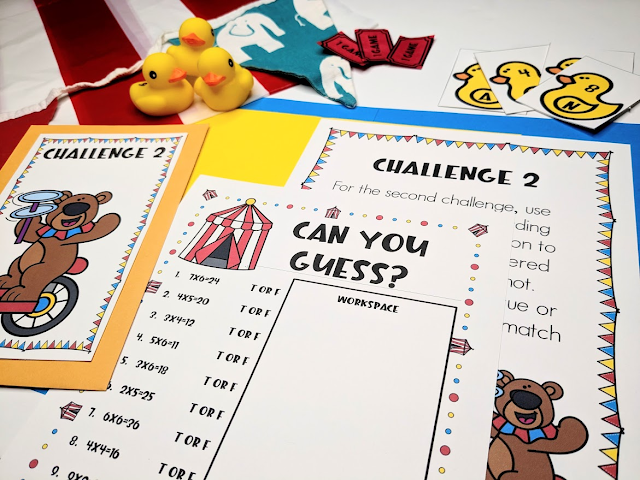
After a pair of students completed challenge one, they received the second challenge. In this challenge, students had to examine multiplication equations that were already solved to determine if the answers were true or false. Then they looked at a set of ducks that had numbers and letters on them. The numbers matched the equation problem numbers. Once they decided which of the equations were true, they took those numbered ducks and lined them up to reveal the next code. Writing it down, they came to me (the ringmaster) to check it and receive a ticket and their next challenge. 

Then it was time for challenge three. For challenge three, students received their envelope with directions. In this challenge, students had circus train cars that had equations on them. Once they solved the multiplication equation, they put the train cars in order from least to greatest products, and that revealed the code. Once again, students checked their secret word/phrase and received a ticket and challenge four when they were correct. 


  Last, students opened their envelopes for challenge 4, students were suppose to play a game of memory match with their partner. Once all the cards were matched, they needed to put the cards in order (by the number on each card) and place the match below. The cards below would spelled out the final clue word or phrase. Students checked this final challenge and received their last game ticket. The first pair of students received a bonus ticket. 

As a side note to this challenge, we started running low on time, and when that happened, I had my students work on this challenge without playing memory match. Instead they simply solved and matched the cards to reveal the code.
 

As students began to finish their challenges, they could use their tickets to play carnival-style games that were set up around the classroom. Students were so excited. I had five different games that students could choose from:

Ring Toss: I had a ring toss game that was marked with different points. Students had to throw the rings, add their score and they won if they reached a certain number of points. 

Basketball: I borrowed a small classroom basketball hoop set that could hook onto my whiteboard. Students threw shots and if they made a certain number of baskets, they won.

Bowling: Students could go bowling and had to knock down a certain number of pins to win.

Nerf Gun Shooting: Students had to use a Nerf gun to shoot a target. If they hit the target, they won. 

Ping Pong Ball Toss: Students had ping pong balls that they tossed into cups. If they landed a certain amount, they won the game. 

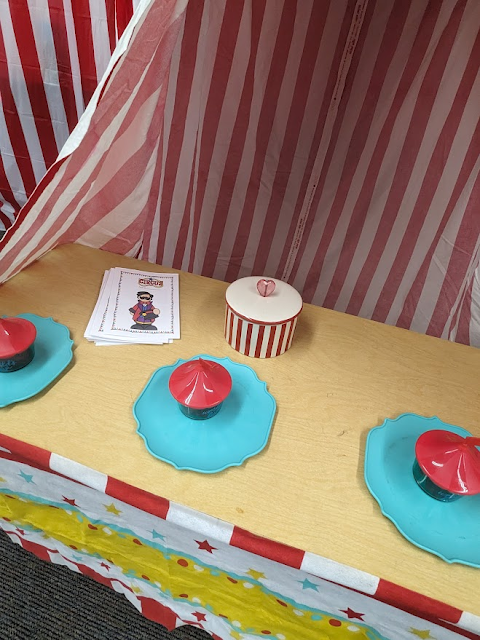
I had a table set up with snacks and prizes. As students played the games, they could visit the table for a prize if they won. 

Ring Toss

Bowling

Prizes - purchased at Dollar Tree

When we completed all the challenges and games, our transformation ended. It was a huge success with lots of smiles, hard work, and celebrations. Each student received a circus peanut to try (most had never tried them). I will definitely be repeating this one again in the upcoming year.

Here are some other views of the decor. 


If you are interested in trying this transformation out in your own classroom, I will link it here. Remember, you can do simple, medium, or challenging decor...the choice is up to you, there is no wrong or right way to decorate, but students will enjoy learning under the big top, however you choose to do it. Click on the picture below for more details.


Sunday, April 27, 2025

Learning the Multiplication Facts


Getting math facts to stick in little minds can be a definite challenge for any teacher, yet is so important that students learn their facts, especially multiplication. Beginning in second grade, students begin to learn the ins and outs of multiplication and build an understanding using pictures and manipulatives. Once third grade hits, multiplication gets even deeper with bigger numbers and the dreaded task of committing all those facts to memory. So, how can you make it a little more fun? How can you get students to want to practice? I have found several ways throughout the years. Here are five fun ways you can make memorizing the times tables a little bit easier.

1.  Sing your facts. Really, find songs that help the students memorize the facts.  I recently purchased a set of songs that are to the tune of popular songs on the radio. The students beg to hear these songs during their lunch time (we eat lunch in the classroom).

2. Do speed drills. Sure, this will not please every kid in class, but what will? The goal is to reach as many as you can. I loved drills as a kid. Lots of kids love it because it feels like a race. We do a one minute drill sheet that focuses on the fact set that we are learning that week. We drill once a week. Students have one minute to write all the answers they can. After that, they write each fact and write those they missed three times. With this model, you see improvement daily. Students get so excited when they tell me that they beat their score from the day before.

3.  Make flashcards. My students have their own set of flashcards that they practice with each day. The way to make it more fun is to have them quiz a partner. Add a timer to the mix and you just ramped up the enjoyment by about 90%. I use sand timers. The students flash the cards to their partner over and over until the one minute is up. While timing their partner, they have to play close attention. If their partner misses a problem, they will tell the answer. Then the other partner will repeat the fact and answer three times before moving on to the next card.

4.  Play games. There are so many games that are so easy to play.
Class Games:  We love to play whole class games such as Around the World, The Stand Up Game, and Multiplication Relay.  
Around the World: Two students stand together at a time. I flash a card and the first student to say the correct answer moves on to the next student. The student that misses, sits down. Continue around the class until every child has had a chance to play. This is a quick and easy one.
The Stand Up Game: Everyone stands up. I use flashcards or just shout out a fact and call on a student. If they answer correctly, they stay standing. If they miss, they sit down. Last one standing wins, or whoever is still standing when the time is up will be proclaimed a winner.
Multiplication. On one side of the field, form two lines. One is team A, the other team B. Halfway down the field is bucket of fact cards for each team. The teacher stands on the other side of the field. When the teacher says go, one student from each team runs to the bucket, grabs a fact, runs to the teacher and says the answer. If a student does not know the answer, he or she must return to their team to get help. Once they know the correct answer, they run to the teacher and tell the answer. The team that answers all their cards first wins.                                                                    
Table Games: I invested in a few times tables games. My students love the game Speed. Another one I use is called………………………………
Computer Games: There are sites on the computer that also have games to practice times tables. One that I have used a lot with my class is multiplication.com. Students can focus on one fact set at a time.
Partner Games: I also love making quick and easy partner games for my class to use during math rotations. Whenever I introduce a new game, students are so excited and ready to practice their facts
5. Host a Multiplication Mania week. Why not kick off your learning of the times tables with a super-focused week of multiplication fun? Spend extra time playing games, singing songs, doing multiplication activities (such as arrays with food or multiplication crafts)? It is fun to do and will be sure to get your kids excited about multiplication.

Find this game here: Search and Rescue: An I-Spy Game


I hope these tips and tricks help you in your own journey into getting your class to learn the times tables. Below are some links to some of the games mentioned above. Simply click the picture and you will be taken to the site where you can find the resource.


Tuesday, November 21, 2023

Multiplication Escape Room and a Circus Classroom Transformation

Over the past couple of years I have done several escape rooms and they have always be a fun learning experience and great way to gamify my classroom. I decided that I wanted to try to create my own circus/carnival themed escape room, and I decided to call it Escape to the Circus because once students finished all the challenges in the game, which was circus themed, they would earn tickets to play carnival games for added fun. Here's how I set it all up.

Circus Classroom Transformation

Many years ago, I would create a new elaborate theme each year for my classroom. One of those years, I created a circus theme because we were learning about the five regions of the US, and since the circus travels the US, this was a perfect theme. I created a circus reading tent and banners and found some cute circus seating at IKEA and that year, Target also had some circus pieces I could add as decor. After creating it all and using it for that year, I packed it all away to use in the future for classroom transformations. I have used it a time or two since, but not for several years. I knew I wanted to pull this out to use with my escape room. That was the main reason I created a circus/carnival theme. The only decor item I purchased this time was the red and white backdrop, which is really a set of three table cloths that I found on Amazon for pretty cheap. I put some circus music on in the background, and the circus vibe was coming together. 


Aligning the Curriculum

Aligning the curriculum was super easy. The hard part for me was that I had to create three versions of each game because I teach in a multi-grade classroom with grades 3-5. Because I had all those grades, I needed a different level of math for each grade level, but I wanted all the grades in my classroom to be able to play the game. 

Since we were just finishing up our units on multiplication, I knew that my topic for this escape room would be multiplication. I would just level up each challenge for an easy, medium, and hard. So for third grade, I kept the challenges easy with basic multiplication facts using two and even three factors. For the fourth grade challenges, I took it up a notch. The fourth grade level included skills like multiplying with powers of ten, multiplying double digits with estimation, and multiplying double digits. For the fifth grade, the skills I focused on were multiplication of decimals using powers of ten, multiplying decimals with estimation, and multiplying decimals. These skills covered most of what we learned during the multiplication units in our actual curriculum. 

Building the Challenges

I decided to do four challenges for my escape room. Each challenge would reveal a secret code word or phrase that was related to the circus. 

In challenge one, students were give an envelope with a puzzle that was precut. The puzzle was easy to prep because I created the puzzle with rectangular shapes only. The goal was to match all the equations to the products. Once all products were in place, letters lined up to create a mystery phrase. I created a foldable where students could write the secret code. Because there were no spaces between the letters in the puzzles, students did not understand the secret code until they started writing it in the blanks in their foldables. This made it even more fun. 


For challenge two, students were given a sheet of 12 math equations that were already answered. The trick was that they had to decide which were true and which were false. Once they found all the ture equations, they used rubber ducks (I also made paper ones as an option) to reveal the code. I wrote a number on the back of each duck, and underneath I wrote  letter. The students would use the numbered ducks that matched the true problems. Once they put those in order, they looked on the duck and found a letter. When the ducks were lined up in numerical order, it revealed a secret word. 


In challenge three, students received a set of circus train cards. Each card had an equation that had to be solved. Once they were solved, the products were put in order from least to greatest to form the circus train. Each train car had a letter on top and when placed in the correct order, the code was revealed. 


For the final challenge, number four, students were able to play a short game of memory match. Once the cards were matched, the letters were written in the order of the card numbers. As an alternative, Students did not have to play memory match (if time was short) instead, they simply matched the card with the equation to the product to find the code. 


Launching the Escape Room

To launch the Escape room, students entered the room to see the circus decor and heard the circus music playing. They each received the foldable, and inside was a letter that I read to them. It welcomed them to the challenge and asked them to complete four challenges to escape to the circus. The students were so excited. Right afterwards, they received their first challenge. We did the challenges with partners, but this could definitely be done individually or even in small groups. I personally preferred the partnerships because it allowed the students to work with someone else to get through the challenges. I think it could work in small groups, but sometimes there is a teammate who sits back while others do the work. In partnerships, that seems less likely to happen.


Playing the Game

As challenges were completed, students each received a game ticket. These were saved to be used after all the challenges were completed. An extra game ticket was given to the team who finished first. It took about two to two and a half hours to complete the challenges. Our math block is about two hours, so it was pretty good, we just finished and let it run into one of the other classes. We adjusted everything else to finish. This could be used over the course of 1 day, two days, or even four days if you did just one challenge a day. The first challenge seemed to take the longest for all of my teams. 

Escape to the Circus

Once the teams completed all the challenges, they escaped to the circus. This meant that they could use their game tickets to play carnival-style games. I set up easy games using what I had and what I could borrow from other teachers in my building. Here are the games I used.

1. Basketball: A teacher friend of mine had a basketball game that clips onto the whiteboard. There were four basketballs that came with this, so the students could each get four tries. If they made one basket, it was a win and they received a prize.

2. Balloon Nerf Game: I blew up several balloons and taped them on a whiteboard. Students had to shoot one balloon with the Nerf gun. There were two foam bullets, so the students each got two tries to win. If they won, they collected a prize.

3. Bowling: A couple of years ago, I purchased a plastic bowling game from Hobby Lobby after the season for 1/2 off. I think I spent ten dollars. We used this for one of the games. It came with two balls, so each student got two tries. To win they had to knock down at least 3 pins. 

4. Ring Toss: My school has a ring toss game, so I used that for another game. In this version, the rings were each numbered with a certain amount of points. Students had many tries (maybe 8-10) to earn 60 points total. 

5. Pong Ball: In this game, I set up Dixie cups and each student had three ping pong balls. They had to toss the balls and land at least one in a cup to win. 

Prizes

For each game the students won, they received a prize. I purchased different prizes from Dollar Tree. I had popcorn...which was very popular, candies, and cookies, and some drinks too. You could also use other non-food prizes such as stickers, toys, games, pencils, erasers, etc. 

This game was so much fun and I cannot wait to create another escape room for my next unit on division. I am already planning an under-the-sea version. 

If you are interested in trying this Escape to the Circus escape room in your classroom, be sure to check out my resource on TPT. The work is already done for you. Your class will have so much fun! Click on the picture below to find out more and purchase.